The global electric vehicle (EV) motor bearings market was valued at $5.81 billion in 2025 and is projected to reach $12.82 billion by 2032, growing at a compound annual growth rate of 11.97%, according to PW Consulting. A separate forecast from Marqstats values the broader EV bearings market at $2.94 billion in 2025, expanding to $5.87 billion by 2030 at a 14.87% CAGR — driven by over 17 million annual EV sales worldwide and the accelerating shift from internal combustion engines to electric powertrains. China alone sold 16.49 million electric vehicles in 2025, anchoring Asia-Pacific as the largest regional market with a 42.3% revenue share.
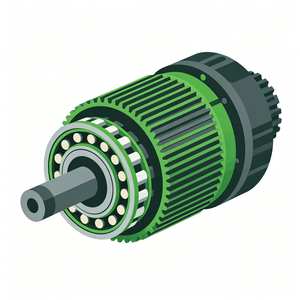
The transition to electric propulsion is fundamentally reshaping bearing requirements. While EV drivelines use approximately 40% fewer bearings than conventional ICE vehicles, each bearing operates under far more demanding conditions — higher rotational speeds, increased electrical stress, and stricter efficiency and noise constraints. This shifts the market from commodity steel bearings toward high-value specialized products: electrically insulated bearings, low-friction high-speed designs, and hybrid ceramic variants. Electrically insulated bearings have become essential in EV traction motors, where high-frequency inverter-driven currents cause stray-current corrosion and electrical pitting that rapidly degrade standard steel bearings. Over 1,000 new product SKUs featuring advanced surface treatments and improved seal designs have been launched, reducing power loss by approximately 10%.
Hybrid ceramic ball bearings are emerging as a critical growth segment, valued at $208.5 million in 2025 and projected to reach $457 million by 2032 at an 11.8% CAGR. Silicon nitride rolling elements reduce rolling resistance by roughly 15% and extend grease life to match 150,000-kilometer service intervals, directly improving drivetrain efficiency and range. Ball bearings currently hold the largest product segment share at 38.5%, while the integration of embedded sensors, AI-driven prognostics, and electrically insulated architectures are identified as the three innovation vectors most decisively reshaping competitive differentiation. As e-axle integration and 800V architectures become standard, the EV bearing market is expected to maintain double-digit growth through the next decade, with thermal management and high-speed durability becoming the primary technical battlegrounds.

jxybearing@jxyautopart.com
Get Quote